Marshall Health Network first in West Virginia to offer histotripsy treatment for liver tumors
Monday, June 29, 2026
Innovative technology made possible through gift from Cabell Huntington Hospital Auxiliary
Marshall Health Network-Cabell Huntington Hospital (CHH) is the first hospital in West Virginia to treat liver tumors with the Edison® Histotripsy System, giving patients access to an advanced treatment that targets tumors with focused sound waves instead of surgery, chemotherapy or radiation.
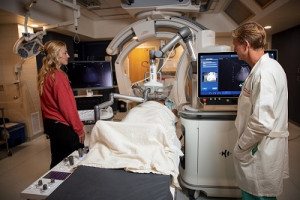 The Edison Histotripsy System uses image-guided sonic beam therapy to precisely target and liquefy liver tumors while preserving surrounding tissue. Supported by more than two decades of research and clinical trials, this FDA-cleared technology has demonstrated strong safety and effectiveness in treating both primary and metastatic liver tumors, expanding the range of treatment options available to physicians and patients.
"Bringing histotripsy to our region reflects Marshall Health Network's commitment to ensuring patients have access to the latest proven advances in cancer care," said Tim Martin, president of CHH. "As the first hospital in West Virginia to offer this technology and among the first 100 in the nation, we continue to lead the way in bringing innovative, evidence-based treatments to the patients and communities we serve."
Unlike traditional surgical approaches, histotripsy requires no incisions, needles or ionizing radiation, which may result in less pain, a shorter recovery and faster return to normal activities for eligible patients.
“For people diagnosed with liver cancer or with tumors that have spread to the liver, this technology opens the door to new treatment options that weren’t available before,” said Nancy Godby, MS-MHA, MA, RT (R)(M) AART, CHC, director of radiology at CHH. “Histotripsy expands our ability to personalize treatment with a precise, non-invasive approach that is backed by years of clinical research.”
The Edison Histotripsy System was made possible through the generosity of the Cabell Huntington Hospital Auxiliary, whose $1.3 million investment brought the technology to West Virginia.
"The Cabell Huntington Hospital Auxiliary has a long history of investing in innovations that improve patient care," said Rev. Davanna Marcum, BS, auxiliary president at CHH. "We're proud to help bring this proven technology to patients in West Virginia, expanding access to advanced treatment when and where it's needed most."
For more information about histotripsy at Cabell Huntington Hospital, visit cabellhuntington.org/histotripsy.
To learn more about the Edison System, visit: histosonics.com.
More news...

Marshall Health Network offers families opportunities for safe Halloween fun

Marshall Health Network Foundations to host second annual PROACT Monster Smash Pickleball Bash Oct. 24

Marshall Health Network names new medical director of Edwards Cancer Institute

The power of connection during the breast cancer journey

Marshall Health Network brings heart failure care together at HIMG campus

Marshall Health Network announces senior leadership updates
Marshall Health Network performs first robotic-assisted joint replacement surgery at Rivers Health